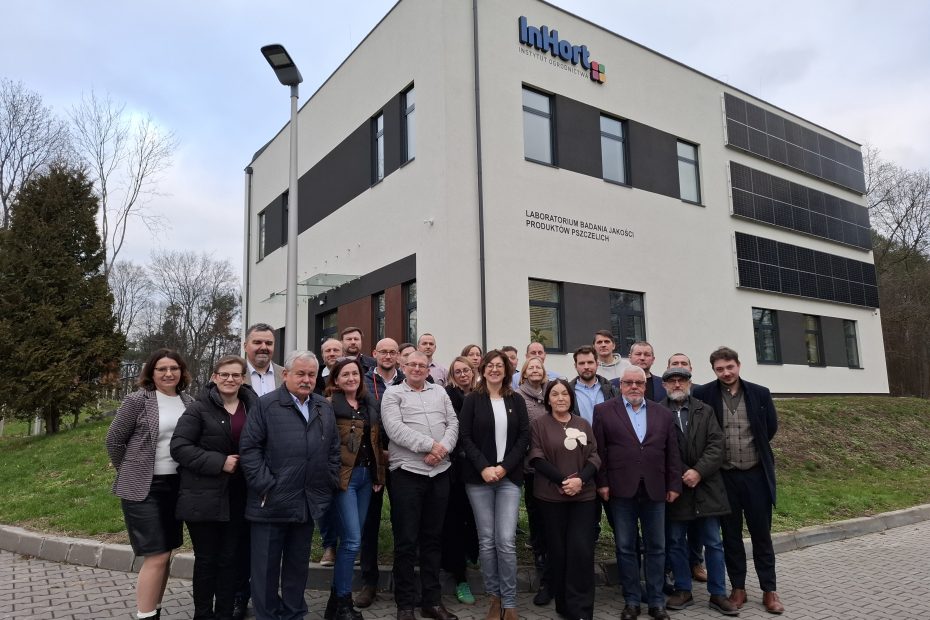
On 4 December 2025, a meeting with representatives of leading bee colonies covered by Genetic Resources Conservation Programmes was held at the Apiculture Division of the Institute of Horticulture in Puławy.
The meeting, organized jointly by the Department of Farm Animal Biodiversity Conservation of the National Research Institute of Animal Production, the Apiculture Division of the Institute of Horticulture in Puławy, and the National Animal Breeding Centre, was attended by a total of 25 people.
Representatives of all leading colonies participating in the genetic resources conservation programme for Central European bees (lines: Północna, Augustowska, Kampinoska, and Asta) and Carniolan bees (Dobra line) were present. Representatives of the scientific community also took part: Prof. Jerzy Wilde, PhD (chairman of the working group for bee genetic resources), Prof. Małgorzata Bieńkowska, PhD, together with employees of the Apiculture Division of the Institute of Horticulture, Andrzej Kobyliński, MSc Eng., from the National Animal Breeding Centre, Michał Kolasa, PhD (NRIAP) and Agnieszka Chełmińska, PhD Eng. (NRIAP) – coordinator for the conservation of bee genetic resources.
During the meeting, information from leading colonies was presented, including a summary of the season and the number of bee families overwintered. The management of leading colonies was discussed, both from the breeding side, in terms of the implementation of the Programme’s tasks, and from the promotional side. Examples of cooperation in the region, using the Dobra line as an example, were also presented by Jerzy Żwirski.
The next item on the agenda was the presentation of information on planned changes in conservation programmes and procedures, which were discussed by Agnieszka Chełmińska, PhD Eng. and Andrzej Kobyliński, MSc Eng. The issue of possible changes to the Act on the organization of breeding and reproduction of farm animals and the current and planned support system for the implementation of bee genetic resources conservation programmes was also raised.
Next, Michał Kolasa, PhD, gave a presentation on modern methods for identifying bee breeds, which could potentially be used in the implementation of conservation programmes.
The meeting ended with a lively discussion and a tour of the bee product quality testing laboratory.


